Cloudflare AI Search GA: What It Means for GEO
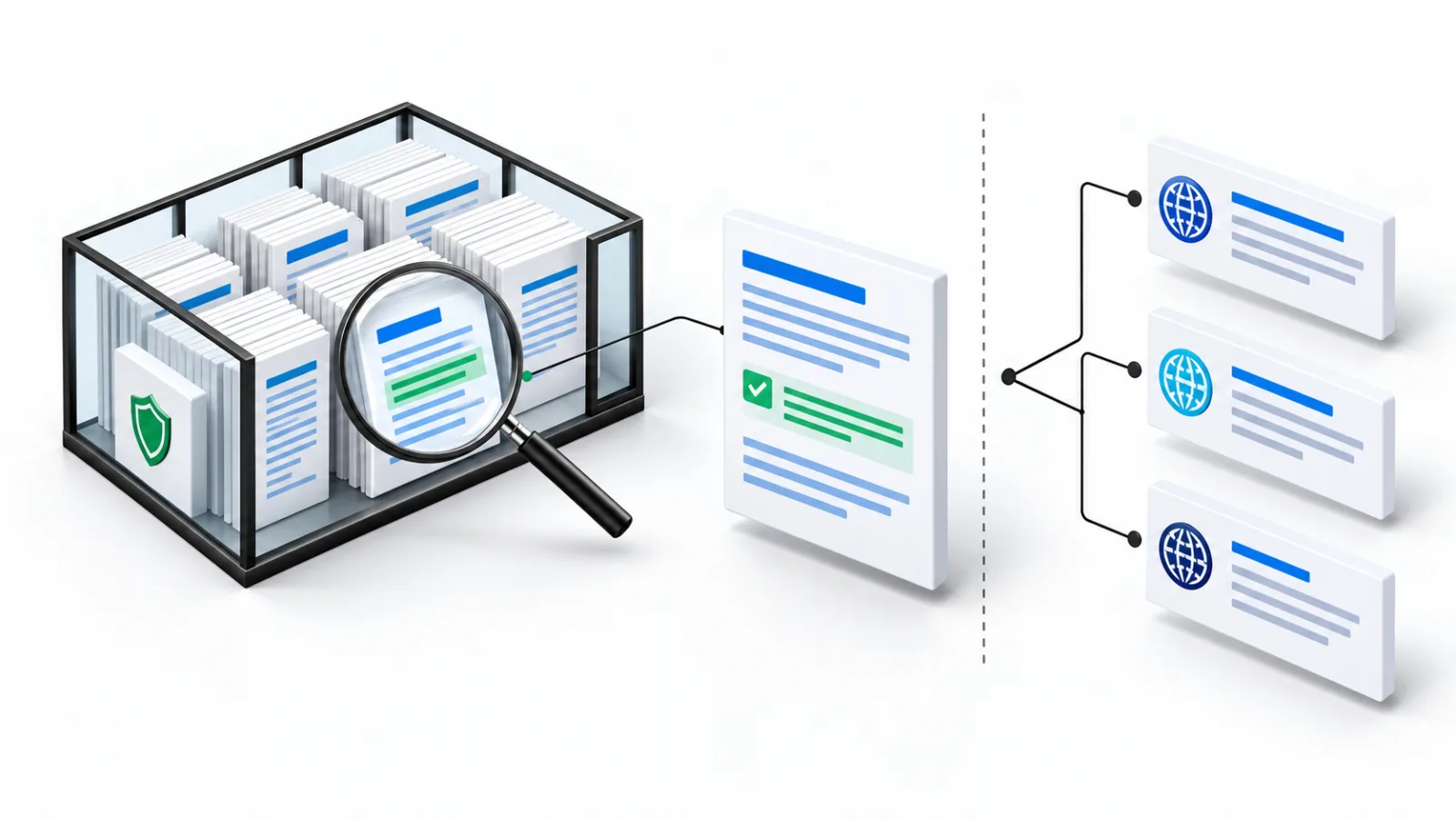
Cloudflare AI Search is a managed service for searching your own content, now generally available. It can power site search and grounded answers, but enabling it does not establish visibility in external answer engines. Use a small, controlled pilot to test retrieval, source accuracy, access boundaries, and user outcomes separately from GEO performance.
What changed in Cloudflare AI Search?
Cloudflare announced general availability on October 1, 2026, alongside native image embeddings, OCR for scanned PDFs, and expanded file support. It also announced that AI Search billing will begin on November 1, 2026. This creates a timely evaluation point for teams considering managed retrieval for documentation, product information, or website search. Cloudflare's launch announcement.
The important distinction is the corpus: this service searches content supplied or connected to your instance. It is not a submission form for earning a recommendation in a public AI assistant. The workflow below is our proposed evaluation method, based on current documentation, not a GEOCARA benchmark or a claim that we have deployed Cloudflare AI Search for customers.
For the wider optimization context, start with the GEO hub. This guide focuses specifically on evaluating managed site search, rather than repeating a general AI-visibility checklist.
Is managed AI search the same as GEO?
Managed AI search improves retrieval inside a system you configure. GEO concerns whether external answer engines discover, understand, and cite your brand or content. The two can benefit from the same accurate source material, but their success criteria differ.
Cloudflare documents an indexing process followed by a query process. Content is parsed, divided into chunks, and indexed; a query retrieves relevant material and can optionally generate an answer. These are configurable application capabilities, not evidence of inclusion in another company's search index. How AI Search works.
| Question | Evidence to collect | What it does not prove |
|---|---|---|
| Can our site search find the correct policy? | Returned source and matching passage | Google has indexed the policy |
| Does our assistant answer accurately? | Answer checked against approved documentation | ChatGPT will recommend the brand |
| Do external engines cite us? | Dated, named-engine observations and cited URLs | Visitors completed a business action |
| Does search help customers? | Verified task completion and conversion events | Every answer or visit was caused by search |
Keep these measurements separate in reporting. Our checker versus mention tracking guide explains why a technical score and an observed citation rate cannot substitute for each other.
Which use case should you pilot first?
Choose one bounded customer task with an authoritative answer set. A documentation team might test installation questions against its current setup guides. A commerce team might test compatibility questions against approved specifications. An agency might help a client search public service documentation without exposing internal proposals.
Avoid starting with every page, every language, and every document version. A broad corpus makes it harder to determine whether a poor answer came from missing evidence, an outdated source, or retrieval configuration.
Write a short pilot contract before configuration: audience, allowed source collection, expected answers, disallowed data, cost owner, and stopping conditions. For example, a wrong cancellation policy or any private-document exposure should block a customer-facing rollout. Those are proposed acceptance criteria, not performance guarantees from Cloudflare.
How do you create a controlled test instance?
The documented dashboard flow starts in AI Search: create an instance, name it, optionally connect an owned website or R2 source, review configuration, and create it. Alternatively, upload approved files through the instance's Items tab. Once indexing finishes, use the Playground's Search or Chat mode to try a query. Cloudflare's dashboard setup guide.
For the first experiment, our recommendation is a deliberately small public collection and a private testing workflow. Keep an inventory containing each source's owner, current version, public URL where applicable, and review date. Exclude customer records, authentication material, draft commercial terms, and documents you are not authorized to upload.
Record the actual configuration with the results. An answer without the source collection, model setting, and test time is difficult to reproduce. Do not present a successful Playground response as proof that a production integration, permissions model, or billing setup is ready.
How should you test retrieval before generated answers?
Retrieval testing asks whether the system finds the evidence needed to answer a question. It is useful to inspect this before judging fluent generated prose. A plausible answer can hide that the wrong document version was retrieved.
Create a question sheet with these columns: question, intended task, expected source, essential facts, forbidden inference, retrieved source, answer verdict, and reviewer. Our suggested question groups are:
- Exact product or feature names, to test precise matching.
- Natural paraphrases, to test whether customer wording finds the same evidence.
- Version-sensitive questions, to expose conflicts between old and current instructions.
- Questions that require a qualification, such as eligibility or regional availability.
- Questions outside the approved collection, where inventing an answer would be unacceptable.
Treat those groups as a practical test design, not a representative sample of all future queries. Include real support questions only after removing personal or confidential details.
When a result fails, change one relevant input at a time. Correct a missing source before changing prompts. Resolve conflicting versions before increasing the amount of retrieved context. Then rerun the same question set and preserve both results. The retrieval and citation explainer provides the conceptual background, but each product's behavior still needs direct testing.
What makes a source citation trustworthy?
A citation is useful only when its source supports the nearby claim. Cloudflare's citation guide describes returned chunks with an item key identifying a document or URL, and shows how to group multiple chunks from the same source. That supports a source list in your interface; it does not remove the need to verify the generated statement. Displaying source citations.
For each test answer, open the linked document and check the exact policy, version, and exceptions. A source list containing the correct product name is insufficient if the answer invents a guarantee that the document never makes.
Design the interface so users can inspect evidence and report a problem. Avoid labeling a retrieval similarity score as a probability that an answer is true. Keep citations readable, remove redundant links, and preserve a clear route to the original source rather than trapping customers inside a generated summary.
What must be checked before exposing search publicly?
Public access is a separate release decision. Cloudflare documents unauthenticated public endpoints and provides configuration for access controls. If protecting a custom hostname with Cloudflare Access, its documentation also warns to disable the default public hostname; otherwise that alternate hostname remains reachable without authentication. Public endpoint documentation.
Our release checklist is straightforward: verify that the indexed collection is appropriate for its audience, test unauthorized access, set request limits, keep credentials server-side, and document how to disable the integration. Test error and empty-result states as well as successful answers.
Do not use a system-prompt sentence as the security boundary for private material. If an answer must differ by customer or permission, have an engineer review authorization and data isolation before publication. This guide is not a substitute for that review, and an anonymous public-source pilot does not validate a multi-tenant private knowledge base.
How should you budget the pilot?
Use the current pricing page rather than assuming a managed service is permanently free. At this article's October 2 check, Cloudflare lists included usage and metered ingestion, storage, and queries, with billing scheduled for November 1. Generation, query rewriting, and external model usage are accounted for through their applicable services. AI Search limits and pricing.
Build your estimate from expected source size, refresh frequency, search requests, and generated-answer usage. Include failed attempts and retries in your own operational measurements. A small retrieval bill does not establish the total cost of the application.
Set a pilot budget and an owner who can stop it. Increase scope only after checking both the results and recorded usage. There is no universal cost per successful answer: the question mix, corpus, configuration, and model choices matter.
How do you measure value without inflating GEO results?
Use three separate records. First, a quality record for approved answers and unsupported claims. Second, a product record for searches, source clicks, task completion, latency, and errors. Third, an external-visibility record for named-engine citations, search performance, and attributable business outcomes.
Label staff tests and automated checks so they do not become customer traffic. Compare equivalent periods and document tracking changes. A higher source-click count may reflect better evidence navigation, but it does not by itself prove higher satisfaction or more sales.
For the public website, use the free AI visibility checker to establish a readiness baseline. Review its scoring methodology before interpreting the result. Google separately states that established SEO practices remain relevant to its AI features; installing a particular site-search product is not one of its stated prerequisites. Google's AI features guidance.
Frequently asked questions
Will Cloudflare AI Search get my website cited by ChatGPT?
Enabling a search instance does not demonstrate that outcome. Test your own retrieval system for its intended use, and measure external citations separately using clearly labeled engine observations.
Should every small website add an AI search assistant?
No. Start from a demonstrated navigation or information-finding problem. A concise site with effective navigation may benefit more from clearer pages than from another interface to maintain.
Can we use the generated answer without showing sources?
That may be technically possible, but we recommend inspectable evidence for factual customer guidance. A support answer should let users verify its basis, especially when terms, versions, or eligibility matter.
Is the free allowance enough for a production launch?
Do not assume so. Check current plan limits and all connected services, estimate actual demand, and compare the estimate with measured usage. A pilot's traffic is not a reliable forecast for a public launch.
What is a sensible rollout decision?
Proceed when the bounded use case meets its documented quality, access, cost, and usability checks. Keep monitoring and a rollback path. Delay expansion when unsupported claims, permissions gaps, or unexplained costs remain.
Your next step
Choose one information-finding task, assemble its approved sources, and write the expected answers before enabling generation. Test retrieval, inspect citations, and record costs. Ship only the scope the evidence supports, while keeping external GEO visibility on its own measurement track. Better site search can be a useful product improvement without being presented as a shortcut to AI recommendations.
Youssef builds GEOCARA and has run visibility probes across AI engines since 2025. He writes from measured probe data, not speculation.
LinkedIn ↗Related GEO guides
Choose your plan
Audit your site and see how AI engines perceive you.