AI Visibility Monitoring Costs: Caching Without Bias
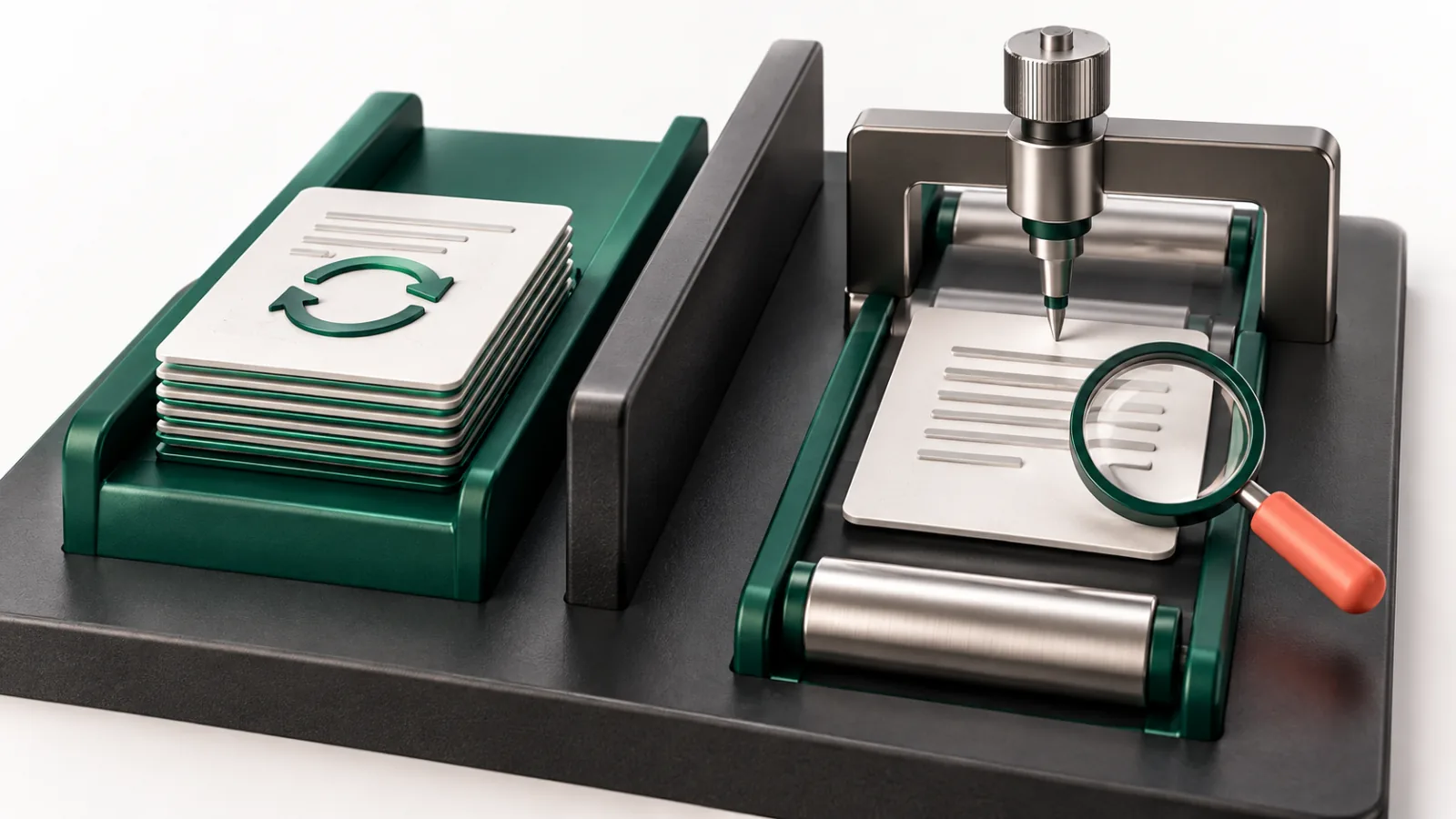
Reduce AI visibility monitoring costs by separating fresh answer collection from repeatable analysis and reporting. Cache work that does not need to change, but never count a reused answer as a new observation. Measure cost per valid observation, retain timestamps and compare equivalent samples before claiming either savings or visibility growth.
What does Cloudflare's new cost study actually show?
On October 19, 2026, Cloudflare published an engineering account of optimizing its internal AI code reviewer. It reported a 68% reduction in average cost compared with its two most expensive weeks before the work. Its discussion includes repeated context, cache behavior and unnecessary calls. This is a first-party operational account, not a controlled benchmark of AI visibility monitoring. Cloudflare's engineering report.
The transferable question is where a workflow spends money without gaining new evidence. The reported percentage is not a target or forecast for GEOCARA, an agency or another monitoring system. Search collection, code review and report generation have different requirements. A cheaper workflow can also become a worse measurement instrument if it quietly replaces fresh observations with old answers.
This article proposes a cost-review process for visibility teams. It does not announce a GEOCARA pricing change or claim that these optimizations are implemented in every product workflow. For the broader distinction between technical readiness and measured visibility, start with our GEO hub. The cover is a conceptual illustration of separate workflows, not a measured product result.
Which parts of monitoring need fresh evidence?
Split the pipeline into collection, analysis and presentation. Collection records an answer under stated conditions. Analysis extracts mentions, citations and other labels from that stored answer. Presentation builds a dashboard, export or explanation from the recorded results. Opening a report again should not automatically mean collecting another answer.
For every operation, ask what new information it is supposed to produce. A fresh collection request may observe a different answer. Reformatting an unchanged citation list usually does not. A new classification method can legitimately reanalyze old text, but its output remains an analysis of the historical observation, not an answer collected today.
Google says its AI Search features use the established foundations of Search rather than a separate set of special technical requirements. That guidance concerns eligibility in Google's experiences; it is not a specification for an API-based monitoring instrument. Preserve the distinction between the surface you observed and the broader product a reader might assume you tested. Google's AI features documentation.
Why are prompt caching and answer caching different?
Prompt caching concerns reusing computation associated with repeated input. Response caching returns a previously stored output. For measurement, those are materially different operations: one may reduce processing work, while the other can eliminate a new observation altogether. Check the behavior of the actual provider or gateway instead of using the word cache as a single feature label.
Cloudflare's AI Gateway documentation describes response-cache matching and exposes a cache-status indicator. Its default cache key includes the provider, endpoint, model, authentication header and full request body; custom keys can override that behavior. Identical requests can therefore return stored responses when caching is enabled. AI Gateway caching documentation.
The practical rule is to label provenance at the collection boundary. Record whether an output was freshly collected, reused from response storage or reanalyzed from an earlier answer. Do not rely on the dashboard generation time as the answer's collection time. A report built this morning can correctly contain historical evidence, as long as it says so.
What work is usually a better candidate for reuse?
Begin with deterministic processing around the observation, then review model-assisted analysis. The following matrix is a proposed decision aid, not a universal guarantee about what a vendor caches or charges.
| Operation | Reuse decision to evaluate | Measurement safeguard |
|---|---|---|
| Parse an unchanged saved answer | Reuse parsed fields | Keep original answer timestamp |
| Normalize citation URLs | Reuse deterministic output | Version the normalization rule |
| Reopen a completed report | Reuse the report snapshot | Display its observation window |
| Classify unchanged text | Reuse only under the same method | Store method and model versions |
| Collect a new comparison sample | Do not substitute an old answer | Record fresh or cached provenance |
Review dependencies before enabling reuse. If a brand's accepted names change, an old mention label may no longer reflect the approved method. If URL normalization changes, a citation count may move even though the stored answer did not. Make the changed rule visible rather than presenting a processing revision as new market behavior.
Our AI visibility versus mention tracking guide helps define which outcome a label is intended to represent. Decide that definition before deciding which intermediate output can be reused safely.
How do you calculate a useful unit cost?
Use cost per valid observation as one operating measure, alongside coverage and completion. Define valid before running the collection: the intended platform or endpoint, question, language, market, collection conditions and acceptable result shape should be recorded. A timeout, an authentication failure and a successful answer are not interchangeable denominator units.
Include the work needed to produce usable evidence. Track collection charges, search or tool charges when applicable, analysis costs and retry costs separately. Record missing price information as unknown. Do not convert a provider's absent usage field into zero cost, and do not mistake an internal estimate for a reconciled invoice.
A proposed comparison sheet should show total recorded spend, planned observations, valid fresh observations, cached responses, failed attempts and coverage by selected platform. That makes a lower total easier to interpret. Spending less because half the intended questions were never collected is a coverage reduction, not automatically an efficiency improvement.
Avoid copying a unit price from another team's article into your budget. Model choice, context size, search behavior and the number of analysis calls can all change the cost structure. Use your own recorded operations and current billing terms for the actual configuration, with an explicit allowance for missing attribution.
Can cheaper models handle the analysis stage?
Possibly, but evaluate the task rather than the model's reputation. Deterministic URL extraction should not need a generative explanation merely to produce a list. Ambiguous brand references may require a different treatment. A cheaper classification step is useful only if its errors are acceptable for the decision the report supports.
Build a reviewed reference set of saved answers containing genuine mentions, citations without mentions, homonyms, aliases and incomplete responses. Run the proposed analysis method against the same material as the existing method. Compare disagreement types, not just an overall agreement percentage that could hide failures on rare but important cases.
If a change alters the scoring method, retain both the historical observation and the method version. Reprocessing the same text can help evaluate the change; it cannot demonstrate that a brand's live visibility improved. Our AI visibility score explainer provides context for interpreting a score's underlying components and limits.
How can scheduling lower cost without hiding gaps?
Choose the observation schedule according to the business question. A stable documentation topic may warrant a different review cadence from a time-sensitive product launch. Describe that as a sampling decision and state its coverage. Do not present a selectively refreshed subset as a complete daily measurement of every market and platform.
Keep a consistent comparison set when changing frequency. If one period covers one language and the next covers three, the totals do not describe the same instrument. Save the question set, selected platforms and collection window with each run. Treat added coverage as added coverage, not an automatic visibility gain.
Separate retries from scheduled observations. A transient failure may deserve a bounded retry, but repeatedly restarting an entire completed batch wastes work and can complicate interpretation. Define which operations can resume, which results are already retained and when the system should stop and report an incomplete run.
What should a cost-optimization pilot include?
Start with one bounded workflow and an explicit spending ceiling. Preserve an unchanged reference configuration while evaluating the proposed processing changes. The pilot should answer whether the same evidence can be handled more efficiently, not whether a different sample happens to produce a nicer score.
Use this proposed release checklist:
- Record the baseline question set, platforms, language and collection conditions.
- Distinguish cached responses from fresh observations in stored results.
- Reuse unchanged parsing and presentation work where appropriate.
- Evaluate changed classifiers against reviewed historical answers.
- Include retries and missing usage attribution in the cost review.
- Compare valid coverage and labeling errors alongside recorded spend.
- Stop at the agreed budget and report incomplete observations honestly.
The free AI visibility checker, subject to its current access conditions, can help start a technical review. It is not a controlled test of this proposed cost methodology or proof of how often an answer engine cites a site. Keep that boundary clear when sharing results with a client.
Frequently asked questions
Is a cached answer useless for AI visibility work?
No. It remains useful historical evidence and can support reproducible analysis or a report snapshot. The problem is relabeling that same answer as a fresh observation or counting it repeatedly as independent evidence.
Does a high cache-hit rate prove the workflow is efficient?
No. Review total recorded spend, valid fresh coverage and the amount of work performed. A cache metric alone does not explain whether the system produced useful new evidence or simply processed more repeated material.
Can a simulated answer replace a real platform observation?
Use simulations for interface development, parsing tests and training examples, clearly labeled as synthetic. Do not mix them into production citation, mention or share-of-voice measurements as if a real platform generated them under the recorded conditions.
Should all clients share one response cache?
Do not share outputs that contain client-specific or private context across tenants. Any reuse design needs explicit isolation and an equivalence rule. A performance optimization is not permission to disclose another account's questions, answers or reports.
Will Cloudflare's reported savings apply to my monitoring?
There is no basis for that promise. Its report concerns its own code-review workflow. Use the engineering questions to design a bounded comparison of your own pipeline, then report the measured result with its coverage and limitations.
Make the cheaper workflow an honest instrument
Audit where new evidence is collected and where old evidence is processed again. Optimize the latter first, preserve provenance and verify classifier changes against reviewed examples. Compare cost with valid coverage, not just request volume. A useful monitoring system becomes cheaper without pretending that an old answer is a new observation.
Youssef builds GEOCARA and has been testing brand visibility with prompts across AI engines since 2025. He writes from measured prompt results, not speculation.
LinkedIn ↗Related GEO guides
Choose your plan
Audit your site and see how AI engines perceive you.