AI Citation URL Migration: Keep Source Links Working
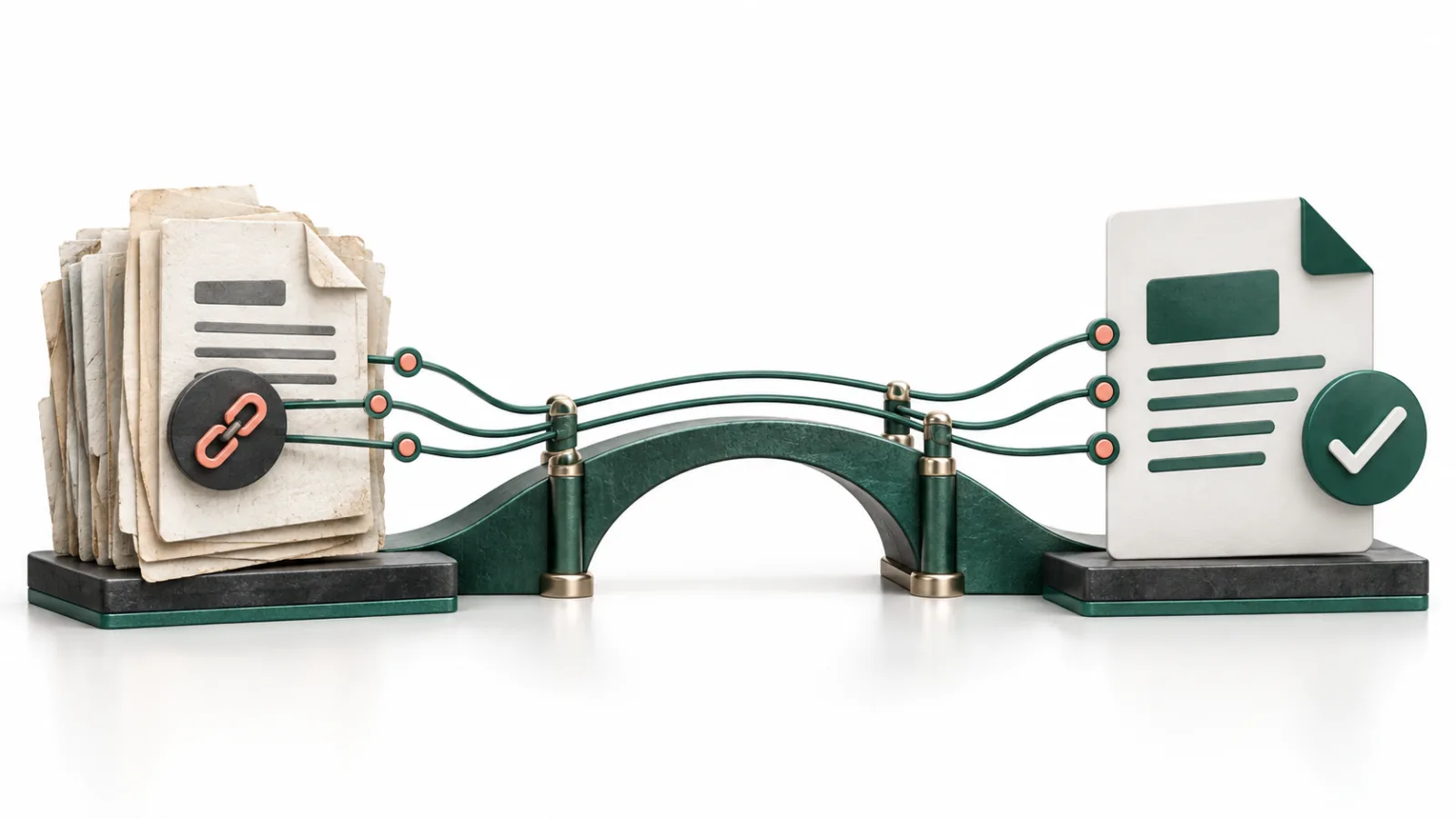
An AI citation URL migration preserves useful destinations when cited pages move. Map old URLs to relevant replacements, test redirects and canonical signals, and retain the evidence behind important claims. Then monitor destination health separately from citation frequency: a technically correct move cannot guarantee that an answer engine will cite the new URL.
Why treat cited URLs as migration assets?
A citation is useful only if its destination still helps someone verify the answer. A redesign can leave an attractive new page while breaking the specific research note, product explanation or methodology that an older answer referenced. The migration problem is therefore not just moving addresses. It is preserving the relationship between a claim and its supporting document.
This guide is an operational checklist proposed by GEOCARA, not a newly announced ranking factor or a universal rule for every AI platform. Google's current guidance says its AI search features build on established Search requirements. It does not promise inclusion for pages that satisfy those requirements. Google's AI features documentation.
Our GEO hub covers the wider visibility discipline. Here, the narrower intent is release management for URLs that have already been observed as sources. The cover is a conceptual illustration of continuity, not a screenshot or evidence of a measured migration result.
Which URLs should go into the migration inventory?
Start with observed source URLs, not a guessed list of pages an engine ought to like. For each saved answer, retain the platform, question, capture date, exact linked address and the passage it supports. Keep the actual destination separate from the visible link label. A citation title alone is not enough to identify a document reliably.
Add your usual migration inventory: important landing pages, downloads, images and linked documentation. Google's site-move guidance recommends mapping old URLs to new destinations and checking relevant assets as well as pages. It also warns that a move can produce temporary Search fluctuations while URLs are processed. Those observations concern Google Search, not a timetable for every answer engine. Google's site-move guidance.
Assign each record an owner and a decision: preserve, move, merge or retire. Do not copy private conversations or customer information into a public tracking sheet. Store only the evidence needed to reproduce a check, with appropriate access restrictions for any saved answer text.
How do you map a citation to a relevant replacement?
Use the reader's verification task as the matching criterion. If an old article explained how a measurement was calculated, its replacement should still explain that calculation. A general product homepage may be live and visually polished without answering the cited question.
The following matrix is a proposed review tool, not an engine scoring formula.
| Old source situation | Recommended review decision | Evidence to retain |
|---|---|---|
| Same document, new path | Map directly to the equivalent page | Old and new text, URL mapping |
| Several documents merged | Check each cited claim in the combined page | Claim-to-section mapping |
| Product renamed | Preserve identity and explain the change | Current product facts and old name context |
| Research superseded | Link to the current finding and explain limits | Original scope, revision date, new methodology |
| No relevant replacement | Retire honestly instead of inventing equivalence | Retirement decision and response check |
For a merge, compare the strongest and weakest destination matches before approving the whole batch. A redirect pattern can be syntactically correct while sending several unrelated documents to the same irrelevant page. Give exceptions explicit mappings rather than relying only on a broad rewrite rule.
What should redirects and canonicals accomplish?
For a permanent move, Google recommends server-side permanent redirects where possible. Its redirect documentation distinguishes permanent and temporary signals; choose the status that reflects the real change rather than treating every redirect as interchangeable. Redirects and Google Search.
Test the old public URL all the way to the final destination. Record each response, final hostname and path, and whether an unexpected login, consent screen or error interrupts access. Repeat with the actual published URL, including its existing trailing slash and relevant parameters. A successful test of a manually cleaned address may miss a broken address already stored in an answer.
Canonical annotations address duplicate consolidation; they are not a substitute for making an old link usable. Google describes redirects and canonical annotations as signals and sitemap inclusion as a weaker signal. Keep the intended canonical destination consistent across those surfaces rather than leaving contradictory preferences. Google's canonicalization guidance.
Avoid turning this into an unsupported promise about AI memory. A redirect does not prove an answer engine has refreshed a source, and a canonical tag does not command an engine to replace a citation. The immediate, testable outcome is that the link reaches an appropriate public document.
What content must survive the move?
Preserve the material that made verification possible: definitions, scope, dates, calculation methods, source references and meaningful limitations. Do not keep a claim while deleting the caveat that made it accurate. When evidence changes, explain the update instead of silently presenting a revised result as the original finding.
For example, imagine a hypothetical pricing comparison moving into a broader buying guide. The new guide might still mention the product but omit the comparison date and eligibility conditions. That is not an equivalent destination for a citation about historical pricing. Either retain a clearly dated explanation or acknowledge that the old comparison is no longer maintained. This is an illustrative scenario, not a customer case study.
Review the visible document before its markup. Our AI metadata QA checklist then helps reconcile titles, descriptions and structured data with the approved page. Metadata that repeats the former claim cannot repair missing evidence in the body.
How should you test before and after release?
Make the release evidence small enough that another teammate can repeat it. For each priority URL, save the old address, intended destination, response chain, final title, canonical, indexing directives and a short description of the supporting passage. Include the date and environment so a staging check cannot be mistaken for production evidence.
Use this proposed acceptance checklist:
- The old address reaches the approved destination without an unrelated detour.
- The final page is public and contains the relevant explanation.
- Its canonical points to the intended current document.
- Internal links and sitemap entries use the approved address.
- Images and downloads referenced by the explanation still work.
- Desktop and mobile layouts expose the evidence without broken controls.
- The migration log identifies the reviewer and any known exception.
Run the same checks after deployment. A local preview cannot verify the production edge, hostname redirects or access policy. The free AI visibility checker can support an initial technical review, subject to its current access conditions; it is not a substitute for inspecting every mapped URL or measuring real citations.
How can monitoring avoid false claims of recovery?
Keep three separate observations: destination health, observed citation selection and human engagement. A working destination answers a technical question. A saved answer with a link answers a platform-observation question. Analytics answers whether a measured session reached the page. None is automatically evidence of the other two.
For repeated answer checks, hold the question, platform, locale and collection method as consistent as practical. Save dates and note changes in the environment. One missing link is a reason to inspect the sample, not proof that the migration caused a permanent loss. Conversely, one new citation is not evidence that every old source reference has been replaced.
Our guide to how LLMs choose citations explains the broader selection problem. Maintain a small unchanged comparison set during a move when feasible. It can help identify whether an observed change is isolated to moved pages, although it still cannot establish causation on its own.
What should the team do when a destination fails?
Triage the concrete failure before rewriting the whole article. If the response chain is broken, repair the mapping. If the final page loads but lacks the supporting explanation, send the issue to the content owner. If the page works and only citation observations changed, collect more comparable evidence before calling it an infrastructure incident.
Give each exception an owner, a timestamp and a retest condition. Keep business decisions separate from technical defects: deliberately retiring an unsupported claim is different from accidentally returning an empty page. Do not retain inaccurate material solely to preserve a historical source link. Accuracy and a clear retirement decision are better than an apparently healthy destination that now misleads readers.
Frequently asked questions
Does a permanent redirect guarantee that AI citations transfer?
No. It can preserve a useful route to the replacement document, but citation selection is a separate observation. Measure the actual answer and destination rather than claiming an automatic transfer.
Should a redesign keep every old URL unchanged?
Not necessarily. Stable addresses reduce mapping work, but some changes are justified. Approve URL changes based on product and information needs, then document the relevant replacements and test them explicitly.
What if an old citation points to a PDF?
Include that exact file address in the inventory. Decide whether the file remains valid, has a relevant replacement or should be retired. Test file access and supporting content, not just the surrounding landing page.
Can a sitemap replace the redirect map?
No. A current sitemap and an old-to-new mapping serve different tasks. Listing a replacement does not make an already stored old link reach it. Verify both discovery signals and destination continuity.
How long should you monitor after launch?
Choose review dates based on your release risk and available observations, not an invented universal AI refresh interval. Continue checking important old destinations and keep reporting technical status separately from citation and traffic changes.
Start with the cited destinations you can verify
Choose a manageable set of observed source URLs, approve their replacements and assign an owner to each exception. Test the complete path before release and again in production. Preserve the supporting explanation, record uncertainty and monitor selection independently. A successful migration keeps evidence reachable; it does not manufacture a citation guarantee.
Youssef builds GEOCARA and has been testing brand visibility with prompts across AI engines since 2025. He writes from measured prompt results, not speculation.
LinkedIn ↗Related GEO guides
Choose your plan
Audit your site and see how AI engines perceive you.