IndexNow for AI Search: A Content Freshness Workflow
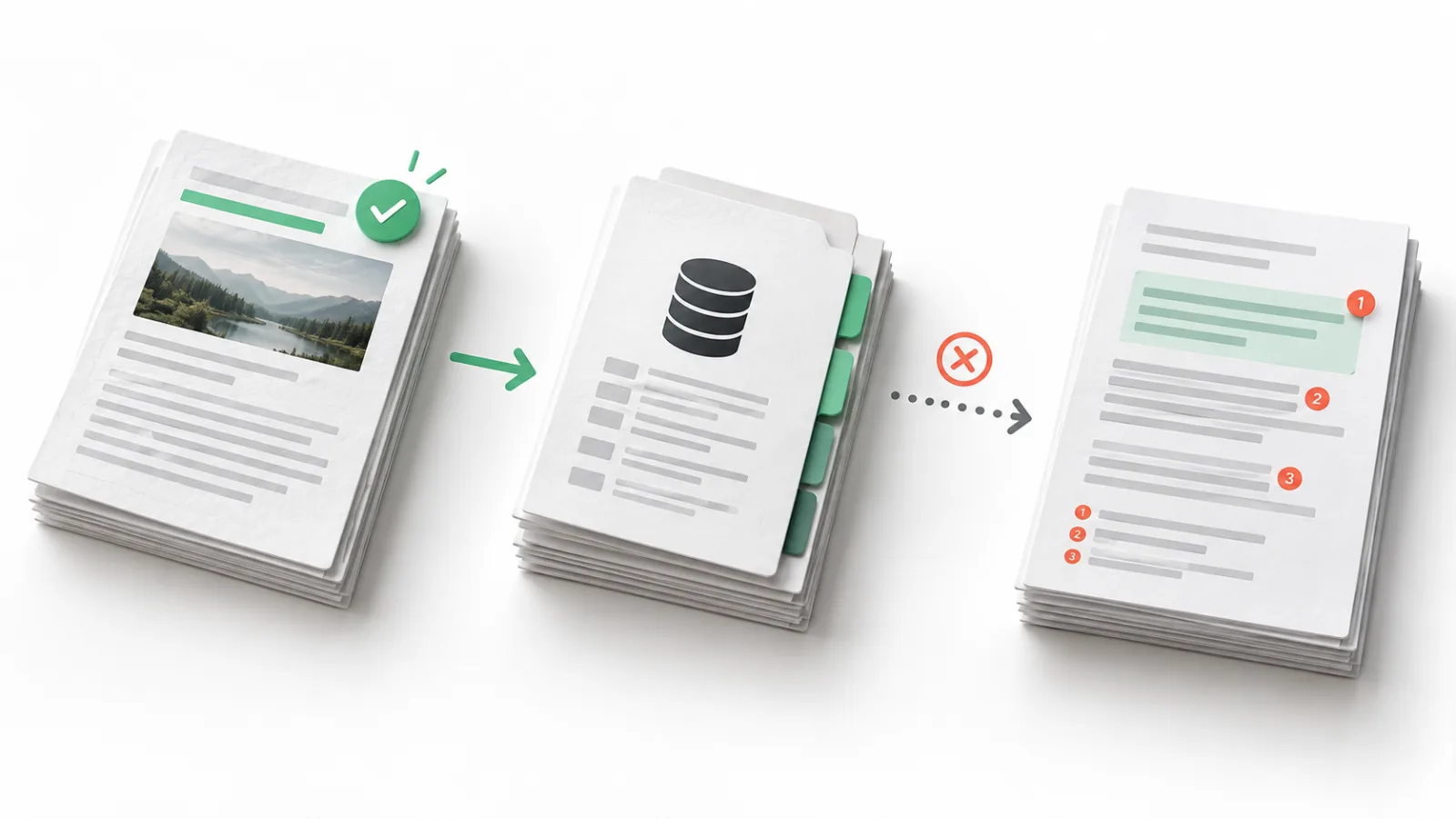
IndexNow notifies participating search engines when a public URL changes. For AI search, its practical role is to help discovery of current information, not to guarantee indexing or citations. Build a workflow that verifies the published page, sends the notification, records the response, and measures indexing, answer citations, and actual visits as separate outcomes.
Why does content freshness need its own workflow?
A corrected product specification is useful only if readers and retrieval systems can reach the corrected version. Publishing a change, clearing the cache, notifying a search engine, and observing a new citation are different events. Treating them as one event makes a successful release look like a proven visibility improvement.
Microsoft describes IndexNow as a way to notify participating engines about additions, updates, and removals, helping keep information fresh across search and AI experiences. That is a discovery mechanism, not a promise that an answer will select your page. Bing's AI Performance announcement.
This tutorial proposes an operational process rather than a new ranking technique. It complements our Bing AI Performance guide: the report measures observed citation activity, while this workflow checks how a meaningful content change reaches the public web.
What should count as a meaningful URL change?
Start with changes that alter the answer a visitor receives. Examples include a corrected eligibility condition, a revised product specification, an updated service area, or the removal of an expired offer. A release that merely changes a decorative border does not deserve the same editorial urgency.
Create a small change record before publishing. Name the affected canonical URL, the fact being changed, the reason, the reviewer, and the publication time. For commercial information, identify the authoritative internal source. For an external claim, preserve the primary reference and its consultation date.
Avoid refreshing dates without reviewing the content. An updated label should describe actual maintenance, not manufacture the appearance of recent expertise. Likewise, do not generate overlapping pages whenever a query variation appears. One accurate, maintained answer is easier to govern than several competing versions.
Use the GEO content audit checklist to decide whether the page needs a factual correction, stronger evidence, better extraction, or a genuine new section. IndexNow should follow that decision, not replace it.
Step 1: Verify the final public version before notifying
Check the deployed URL from outside your authenticated editor. The response should match the intended state: a useful live page for an update, a deliberate redirect for a move, or an appropriate removal response for deleted content. Do not notify a draft, an internal preview, or a URL that still serves the old cached version.
For a live article, inspect the title, canonical, main heading, revised passage, images, internal links, and indexability controls. Confirm the corrected fact appears in the delivered page, not only in the content management interface. If rendering is necessary, test the rendered result as well as the initial response.
Run a free AI visibility check as a technical starting point, while keeping its scope clear. A readiness check is not evidence that every engine has crawled the page or that the current answer sample cites it. Our GEO hub explains why technical eligibility and observed visibility belong to different measurement layers.
Step 2: Check the existing integration and host ownership
Before adding another integration, ask the developer or hosting team whether submissions already occur through the CMS, an extension, or the hosting platform. The official FAQ recommends checking existing support before implementing manually. Two independently configured senders can make troubleshooting and ownership unnecessarily confusing. IndexNow setup guidance.
For manual implementation, use the protocol's host-verification mechanism and follow its key-file rules. Confirm that the public file is reachable on the intended host and that the submitted URLs are within its permitted scope. A staging host and a production host are not interchangeable.
Assign one team owner for submission configuration and one for content approval. Keep unrelated credentials, private report links, authentication tokens, and customer data out of submitted URLs. Notification should concern intentionally public resources, not everything an application can generate.
The protocol documentation defines single-URL and batch requests, ownership validation, and response meanings. Implement against that reference rather than copying an unverified example that silently points at the wrong host.
Step 3: Notify only after a successful publication
Place the notification after the publication has passed its acceptance checks. A deployment trigger alone is insufficient: a build can complete while a page remains unavailable, misconfigured, or unchanged at the public URL. Keep the notification dependent on the verified release outcome.
Record the exact URL, a release or content revision identifier, submission time, endpoint, and response status. Do not describe the response field as an indexing status. The protocol explicitly distinguishes receipt from indexing: HTTP 200 confirms receipt; HTTP 202 means receipt with key validation pending. Response definitions.
For retries, preserve the original change record and add the subsequent attempt rather than inventing a new content update. Use bounded retry behavior for temporary failures. Repeatedly submitting the same unchanged resource is not a substitute for investigating a verification or publication problem.
This suggested workflow does not assert that every GEOCARA publication path already performs these steps. Confirm the implementation in your own publishing integration before describing notifications as automatic.
Step 4: Separate operational evidence from search outcomes
The following acceptance table is a proposed team worksheet, not a provider scoring system. Each row has a different evidence source and a different owner. Keeping them separate prevents a green deployment check from becoming an unsupported claim about AI recommendations.
| Stage | Evidence to retain | What it does not prove |
|---|---|---|
| Publication | Public response and corrected passage | Search engine discovery |
| Notification | URL, timestamp, response status | Index inclusion |
| Index review | Engine-specific inspection result and date | Citation in an answer |
| Citation observation | Engine, question, date, cited URL | A human visit |
| Referral measurement | Analytics source and landing page | A new customer |
| Conversion | Recorded signup or other defined event | Causal impact of one notification |
Investigate a failure at the earliest unsupported stage. If the corrected passage is missing publicly, fix publication before resubmitting. If the page is accessible but not indexed, inspect the engine's own evidence. If indexing is confirmed but no citation appears, review relevance and the monitored question set rather than assuming notification failed.
Step 5: Inspect indexing without inventing a deadline
Choose a documented review cadence appropriate to the content's importance. An expired offer may need urgent manual follow-up; an explanatory guide may tolerate a slower check. These are business operating choices, not promised search engine processing times.
When an inspection tool is available, preserve its property, URL, status, observation time, and any reported crawl information. If the tool is inaccessible or the report is delayed, mark the result unavailable. Do not replace an account-level inspection with a generic search result and call the two equivalent.
Review canonical selection, redirects, robots rules, and accidental exclusions when the observed state conflicts with your expectation. Keep sitemap entries consistent with intended live canonical pages. Removing a URL from a sitemap alone does not document that a search engine has removed it from its index.
The official IndexNow FAQ is also useful for integration troubleshooting. A notification can draw attention to a changed resource; it cannot make poor-quality, inaccessible, or irrelevant content deserve inclusion.
How should you measure AI citations after an update?
Define the question set and baseline before making the change. Preserve engine, language, country where relevant, date, and cited URL. Repeat comparable observations rather than selecting only the answer that favors your brand. Record whether the updated fact actually appears, not merely whether the domain is mentioned.
Distinguish a brand mention from a source citation and from factual accuracy. An answer can cite your page while retaining an old detail; it can also state a correct fact without linking to you. Neither observation should be silently converted into the other.
Bing's reporting documentation explains that citation volume can change with user demand, freshness, model updates, partner refresh cycles, and topic mix. A before-and-after difference therefore does not isolate the effect of an IndexNow notification. AI Performance report scope.
For stakeholder reporting, label the outcome carefully: published, notification received, indexing observed, citation observed, referral measured, or conversion recorded. These labels are more actionable than a single unexplained success percentage.
What should happen when the process fails?
Keep a short exception queue with the failed stage, evidence, owner, and next check. Group repeated configuration errors instead of asking editors to resubmit every affected URL manually. Resolve systemic host or verification problems before increasing submission volume.
A failed notification should not cause an already-correct page to be rolled back. Conversely, a successful notification should not close an incident if the public page contains an incorrect price or policy. Publication accuracy and notification delivery need independent acceptance criteria.
Keep visibility experiments small enough to interpret. If the team changes navigation, page content, canonical tags, and analytics configuration together, document all four changes. Report associations and unresolved uncertainty instead of attributing the result to the notification alone.
Frequently asked questions
Does a successful IndexNow response mean my page is indexed?
No. Receipt is an operational acknowledgement. Index inclusion requires separate evidence from the relevant engine. Keep these two states in different fields in your release log.
Can I replace my sitemap with this workflow?
Do not treat a change notification log as your page inventory. Maintain a coherent sitemap for intended indexable canonical pages, and use notifications to communicate meaningful changes.
Should I submit private dashboard or customer report URLs?
No. This workflow is for intentionally public content. Review access controls and URL parameters before allowing an automated publisher to submit resources.
Is a citation increase proof that the notification worked?
It may be consistent with the change, but it does not establish causality. Compare equivalent observations and consider competing changes, question mix, report delays, and model behavior.
What is the smallest useful first implementation?
Choose one maintained public page, verify a real correction, record its notification outcome, and inspect indexing separately. Expand only after the team can explain each stage and handle failures.
Start with one traceable content update
Select a page whose accuracy matters, publish a supported correction, verify the public result, and retain the notification evidence. Schedule an index review and a separate citation observation. The goal is a reliable freshness process with honest measurement, not a promise that a submission can purchase a place in an AI answer.
Youssef builds GEOCARA and has run visibility probes across AI engines since 2025. He writes from measured probe data, not speculation.
LinkedIn ↗Related GEO guides
Choose your plan
Audit your site and see how AI engines perceive you.