Multilingual SEO for AI Search: A Practical Guide
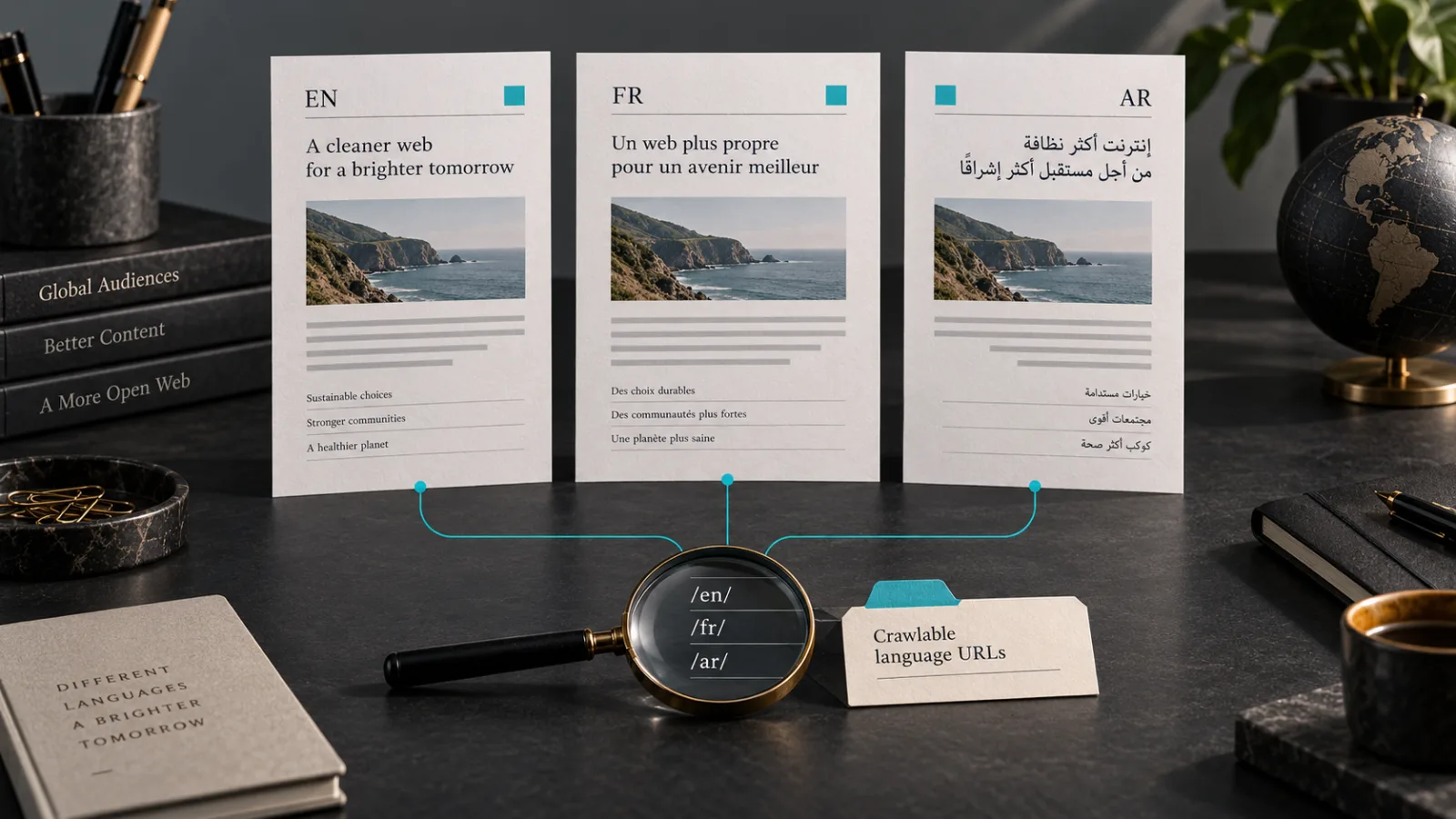
Multilingual SEO for AI search means publishing useful, accurate language versions on discoverable URLs, then checking whether search engines and answer engines can retrieve them. Start with a small reviewed content set, connect equivalent pages with language annotations, preserve consistent product facts, and measure citations and conversions separately for each target market.
A language selector is not evidence of multilingual visibility. Your visitors may see French while a crawler receives only English; an assistant may quote an outdated regional price even when the translation reads naturally. The practical question is whether each audience can find a stable, trustworthy answer and complete the next step.
This tutorial focuses on multilingual content architecture and validation, not another general SEO checklist. For the broader framework, use our GEO hub and AI SEO beginner tutorial. The workflow below is a proposed implementation method, not a claim that translation guarantees traffic or AI recommendations.
What changes when you translate for search, not just readers?
A translated page is a publishing asset with its own address, maintenance owner, and quality checks. A browser translation or dynamic overlay can help someone read, but does not by itself establish a separately discoverable language page.
Google recommends separate URLs for language versions rather than relying on cookies or browser settings. It also recommends making the language clear in the visible content and letting people choose another version through links. See Google's multilingual website guidance.
Do not assume every translation plugin behaves the same way. Inspect its actual output: some publish persistent localized pages; others change text only after an interaction. The acceptance test is the delivered page, not the plugin's marketing label.
For Google AI Overviews and AI Mode, a supporting page must be indexed and eligible to appear with a Search snippet. There is no special AI schema required, and meeting the requirements does not guarantee inclusion. Google's AI features documentation makes this distinction explicit. Treat those requirements as Google-specific guidance, not a promise about every answer engine.
Step 1: Choose one market and a complete user journey
A multilingual pilot should solve one audience's task from discovery to conversion. Start with a market you can support operationally, rather than translating your entire archive because automation makes it possible.
For a B2B software company, a useful pilot might include the product explanation, one practical guide, pricing, a demo form, and the confirmation message. This is an illustrative scope, not a mandatory page count.
Create a working inventory before translation:
| Asset | Decision to document | Acceptance evidence |
|---|---|---|
| Product page | What is available in this market? | Product owner approves claims |
| Pricing | Currency, tax wording, billing terms | Commercial owner approves details |
| Tutorial | Local terminology and realistic examples | Fluent reviewer completes the task |
| Demo form | Language of sales follow-up | Successful test submission |
| Confirmation | Next step and response expectation | Message matches the actual process |
Assign one owner to keep facts synchronized. A translated promise of local support is misleading when the support team cannot provide it. Fix that mismatch before investing in additional traffic.
Step 2: Publish stable language URLs
A stable language URL returns the intended content without requiring a stored preference. For a pilot, a simple structure such as example.com/en/product and example.com/fr/product is easy for a team to inventory and test. This is an organizational choice, not a claim that subfolders always outrank other architectures.
Test each address in a clean browser session. Then fetch it without cookies and inspect the HTML. Confirm the product explanation, title, main heading, and next-step link are in the intended language. Where your framework permits, deliver essential text in the initial HTML to reduce dependence on client-side execution.
Google warns that locale-adaptive pages can hide variations from its crawler; Googlebot normally sends no Accept-Language header, and its default location is the United States. See its locale-adaptive crawling guidance.
Keep user preferences as convenience features. A visitor who deliberately opens a French URL should not be forced back to English because of location. Test from a fresh session and after switching languages, including the browser's back button.
Step 3: Connect equivalent pages without collapsing them
Language annotations describe equivalent versions; canonical tags identify preferred URLs. They solve different problems.
Google's hreflang documentation requires fully qualified alternate URLs, a reference to the page itself, and reciprocal links between variants. Use supported language codes; add a region only when the page actually targets that regional audience.
An illustrative English page could include:
<link rel="canonical" href="https://example.com/en/product" />
<link rel="alternate" hreflang="en" href="https://example.com/en/product" />
<link rel="alternate" hreflang="fr" href="https://example.com/fr/product" />
The French page would carry the same alternate pair and its own appropriate canonical. Do not point every translated page at the English canonical by default: Google advises specifying a canonical in the same language when available. Review its canonicalization guidance.
Build the mapping from actual published equivalents. An unrelated category page is not a substitute for a missing translation. Keep a record of missing variants and remove broken references when retiring a page.
Step 4: Review meaning, product facts, and evidence
Translation quality is a factual review process, not just a grammar check. Use a glossary for product names, category terminology, acronyms, and terms that should remain unchanged.
An API can assist with translation production. Google's Cloud Translation overview describes programmatic translation and advanced capabilities such as glossaries. An API response is still only an input to your publishing workflow: your team must handle storage, review, URLs, updates, and release approval.
Review every pilot page against three questions:
- Is the promise unchanged? Check quantities, exclusions, dates, and eligibility against the authoritative source.
- Is the local context correct? Confirm currency labels, examples, service coverage, and contact paths.
- Can someone verify the answer? Preserve useful source links and explain when a linked document is only available in another language.
For AI-readable content, write a direct answer in the target language before elaborating. Preserve qualifications inside the same paragraph so an extracted passage does not turn a conditional statement into a universal claim. Our GEO content audit checklist helps review the resulting page.
Automated translation is not a reason to publish unlimited thin pages. Google's scaled content abuse policy addresses large-scale, low-value content produced primarily to manipulate rankings, including abusive transformation of existing material. Evaluate usefulness and purpose, not merely the tool used.
Step 5: Run a release test across every language
A release test should catch both technical failures and broken customer journeys. Apply the same checklist to each pilot URL, then record the exact page and observation date.
- The address returns the intended page with HTTP 200, without login or a language-selection prerequisite.
- Important content is readable, and no unintended
noindexor crawler restriction blocks discovery. - Title, description, heading, navigation, and form feedback use the intended language.
- Canonical and alternate links resolve to the correct published pages.
- Structured data agrees with visible product facts, authorship, and content.
- Language switching preserves the topic instead of sending every visitor to the home page.
- Long translated labels, right-to-left layouts where applicable, and mobile forms remain usable.
- The analytics event identifies the page or locale without collecting unnecessary personal data.
Inspect representative URLs in Google Search Console. Its URL Inspection documentation distinguishes live accessibility tests from indexed data: a successful live test does not prove indexing, and the Google-selected canonical is available in the indexed result.
Use the free AI visibility checker as an additional technical baseline, not proof of live citations. For a retrieval-oriented investigation, follow our ChatGPT website access guide.
Step 6: Measure language-specific visibility and conversion
A multilingual measurement plan separates technical readiness, observed answers, and business outcomes. Avoid rolling them into one score that hides why a market is underperforming.
Choose a small set of genuine customer questions per market. Ask a fluent reviewer to adapt the intent rather than mechanically translate every prompt. Record the engine, date, language, relevant location settings, answer, cited URL, and any factual error. Recheck the same questions under comparable conditions; a single response is an observation, not a stable ranking.
Maintain three separate views:
| View | Useful observations | What it cannot establish alone |
|---|---|---|
| Search discovery | Indexed URLs, impressions, clicks by localized page and country | Actual visitor fluency or an AI citation |
| Answer sampling | Brand mentions, cited language URLs, factual accuracy | Population-wide visibility or causation |
| Website conversion | Localized entrances, completed forms, qualified sign-ups | Every exposure inside an AI interface |
Page language and searcher country are not interchangeable. A French page can serve readers in several countries. Keep the URL and audience definitions visible in the report, compare equal observation windows, and label missing sources as unavailable rather than zero.
A practical rollout and rollback decision
Publish the pilot only when a reviewer can complete the full journey in the target language. Keep an inventory of the deployed URLs and their previous versions so an incorrect price or broken form can be corrected promptly.
During the first review cycle, examine failures before expanding: inaccessible pages, incorrect canonical selection, mixed-language templates, misleading claims, or missing conversion events. Do not treat a short period without citations as proof that localization failed.
Expand when the process is maintainable and the evidence is interpretable. If the team cannot keep five important pages accurate, translating hundreds will multiply that maintenance problem.
Frequently asked questions
Should a language selector use country flags?
Language names are usually clearer because one language can serve several countries. Test the selector with your actual audience, including keyboard navigation, and distinguish language from regional service availability when both matter.
Should every language version have identical examples?
No. Keep underlying product facts consistent, but adapt examples where local context genuinely improves understanding. Label differences in availability or terms instead of making regional pages appear interchangeable when they are not.
Can a translation API replace a multilingual CMS?
Not by itself. A translation API produces translated material; a publishing system still needs to manage page addresses, editorial approval, versions, and updates. Decide who owns those responsibilities before selecting tools.
How should we handle an untranslated page?
Offer a clear route to an available version and identify its language. Do not pretend an English page is French through its label alone. Prioritize the missing translation according to user need and your review capacity.
What should happen when the source page changes?
Flag its translations for review and track which facts changed. Assign an owner and a deadline appropriate to the risk. Pricing or eligibility corrections need different urgency from a minor stylistic edit.
Start with one journey you can keep accurate
Choose one market, map its essential pages, and review the complete experience before release. Verify discovery, inspect real answers, and measure qualified actions separately. Multilingual AI visibility starts with reliable localized information; translation volume is not a substitute for that foundation.
Youssef builds GEOCARA and has run visibility probes across AI engines since 2025. He writes from measured probe data, not speculation.
LinkedIn ↗Related GEO guides
Choose your plan
Audit your site and see how AI engines perceive you.