Google AI Search Links Update: A Publisher Checklist
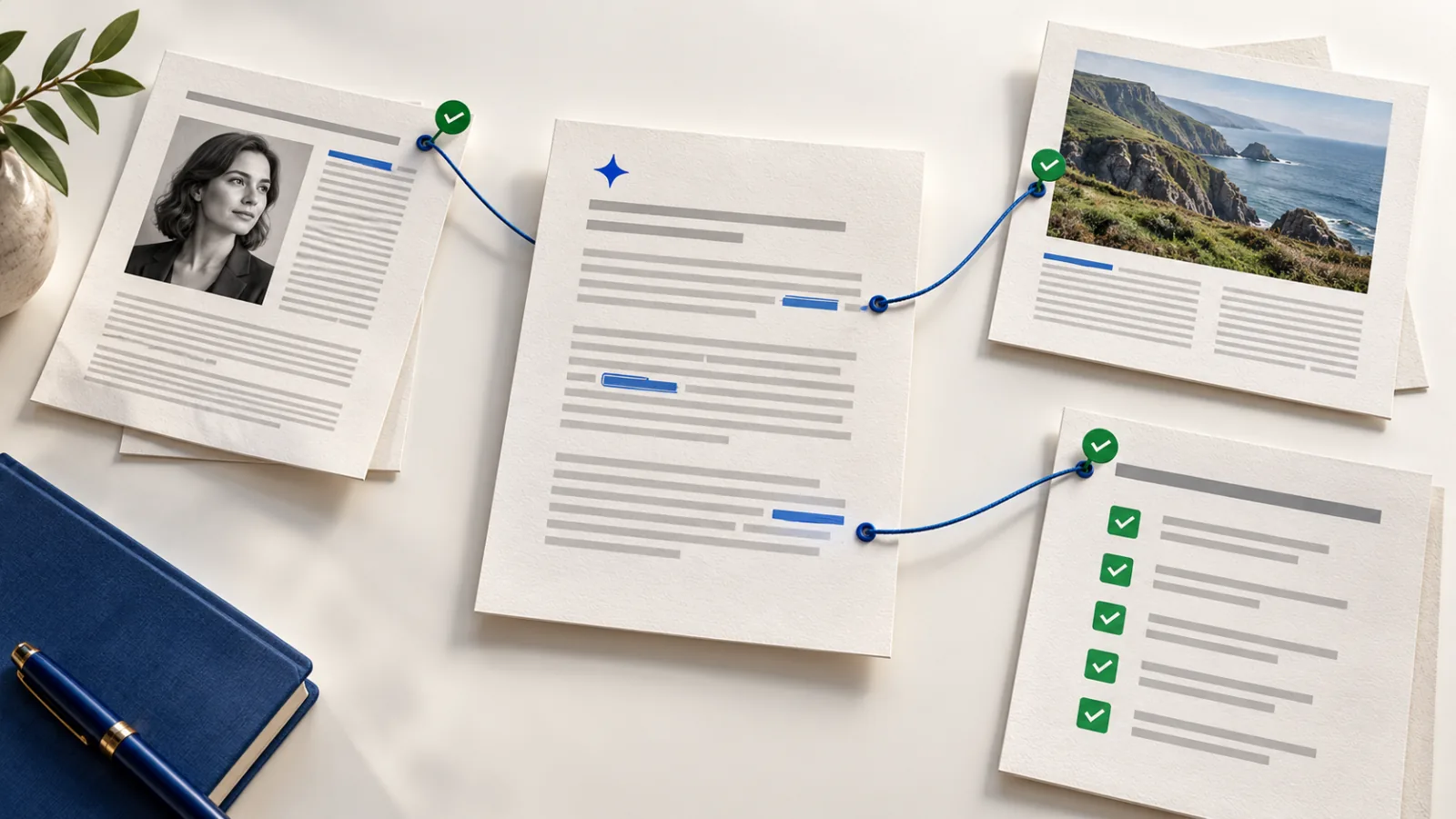
Google's October 15 AI Search announcement changes how links and source context can appear in AI Mode and AI Overviews. Publishers should audit the destination behind each link: the answer, official identity, evidence, imagery, and next step. Record what is actually visible in your market, then measure visits and conversions separately from citation appearances.
What did Google announce on October 15?
Google described five presentation changes across its AI search experiences: more prominent inline links; a test of dedicated official-page sections; broader rollout of timely-article carousels; more visual related-article links; and a test of clickable creator or publisher names on video results leading to Search profiles. The announcement mixes updates, rollouts, and tests, not a universal launch of every format. Google's announcement.
That distinction matters before an editorial team changes its roadmap. A new presentation opportunity does not prove that your property receives it, that a particular query triggers it, or that more users will visit your site. This article proposes a practical response to the announcement; it does not report a GEOCARA experiment with the new formats.
The useful question is narrower than how to optimize for all of AI search. It is whether the page a reader reaches from a source link actually fulfills the expectation that link creates. Use our broader AI Mode optimization guide for the foundation, and this checklist for the current presentation update.
Step 1: Record the observed format before interpreting it
Create an observation sheet with the date, query, language, country, device, signed-in state where relevant, visible result type, linked URL, and screenshot. State whether you observed AI Mode or AI Overviews. If the feature is absent, record absence in that observation rather than extending it to every user.
Keep the observation separate from your explanation. A link appearing nearer the beginning of one answer is an interface observation. A claim that your authority increased is an interpretation requiring different evidence. Likewise, a screenshot cannot reveal the number of people who saw the result or clicked it.
Select a small, stable set of questions your audience genuinely asks. Include learning, comparison, and task-completion needs where those are relevant to your site. Do not choose only branded queries or only the screenshots where your page appears. Preserve the same context when repeating the review.
For multinational teams, avoid collapsing several markets into a single yes-or-no availability field. Keep each observation tied to its context. A test in one session is useful evidence about that session, not a rollout map.
Step 2: Check whether the landing page answers the linked promise
Treat the destination URL as the unit of editorial work. Read the linked passage or result context, open the destination, and ask whether a visitor can find the promised answer quickly. A broad homepage may be useful for navigation, but it may be a poor destination for a detailed technical condition or comparison.
Put the central answer near the start, then supply the evidence, exceptions, and practical detail needed to understand it. Use precise headings and descriptive internal links. Avoid making a reader search through an unrelated sales introduction to locate the fact implied by the result.
Compare the answer with the current public product or service. Check prices, eligibility, geography, dates, and version-specific claims where applicable. An accurate source link can still lead to a stale destination. Correct the page rather than treating citation presence as a quality certificate.
The GEO content audit checklist can organize this review. A free AI visibility check can help surface technical issues, but it cannot prove that Google's announced display will select the page or that a visitor will convert.
Step 3: Make official identity clear without manufacturing authority
An organization should make its official task pages easy to recognize. Review the company identity, service scope, contact information, relevant policy pages, and the relationship between the page and its accountable publisher. Make genuine task destinations discoverable through clear navigation.
Do not interpret an official-page display as permission to create pages that imply a relationship you do not have. A comparison article about another company is not that company's official support page. An affiliate review is not an independent product test merely because its layout includes a professional portrait.
For content with an author, show the person or organization actually responsible. Keep qualifications accurate and relevant. Identify editorial review when it happened, and distinguish a real reviewer from a generic author label. Do not invent experience, credentials, or a biography to make the page look more authoritative.
Review identity across the destination, author profile, contact information, and structured data. Consistency helps a reader understand responsibility; it does not create a guaranteed search treatment. The GEO hub provides context for connecting technical accessibility with useful, accountable content.
Step 4: Audit image relevance and delivery
Review the images attached to important articles and landing pages. Does the visual help a reader recognize the subject? Is it genuinely related to the page, or merely decorative? Can the full-size asset load on a mobile connection, and does the page reserve space so the layout remains stable?
Use descriptive alternative text when an image conveys information, and avoid inserting keywords that do not describe it. Check that the relevant image is accessible and supported by explanatory surrounding text. Google's image documentation recommends descriptive context and high-quality images, while emphasizing that image quality and loading performance need to be balanced. Google's image guidance.
A generated illustration should not be presented as a screenshot of a feature, proof of a product test, or a photograph of a real person who does not exist. Label and use it according to its actual purpose. This article's cover is a conceptual illustration, not Google's interface.
These checks improve the destination and its assets. They do not establish that an article will receive a thumbnail in a specific AI answer. Preserve that boundary in briefs and client reports.
Which checks belong in a publisher handoff?
The worksheet below is a GEOCARA proposal for a page review. It is not a Google scoring formula or a claim about the selection algorithm. Assign an owner and retain evidence for each applicable row instead of producing an unexplained readiness percentage.
| Review area | Question to resolve | Evidence to preserve |
|---|---|---|
| Observation | Which format did we actually see? | Dated query context and screenshot |
| Destination | Does this URL fulfill the linked promise? | Current answer and relevant section |
| Identity | Is the accountable publisher clear? | Visible organization or author information |
| Accuracy | Are changing claims still correct? | Primary references and review date |
| Imagery | Is the relevant asset useful and accessible? | Public image response and mobile inspection |
| Measurement | Can we separate exposure from outcomes? | Report scope, analytics events, and definitions |
Prioritize a failure that can mislead a reader ahead of a cosmetic issue. An incorrect eligibility condition deserves attention before a decorative cover change. If the selected page already serves the intent well, avoid creating a near-duplicate URL solely to chase a new display.
What technical requirements still apply?
Check the ordinary foundations before inventing special AI markup. The page should be publicly reachable in its intended form, its canonical should match the preferred resource, and accidental indexing or snippet restrictions should be investigated. Confirm that important content is available in a useful textual form.
Google states that supporting links in AI Overviews or AI Mode require an indexed page that is eligible for a Search snippet. It does not promise crawling, indexing, or serving, and says no additional special technical requirements apply. Google's AI features documentation.
Make structured data agree with the visible page. Do not add unsupported author claims, invisible FAQs, or schema types that describe something the page does not provide. Technical checks can establish readiness and identify defects; they cannot certify a future citation.
After a real correction, confirm the public version and review discovery separately. Our IndexNow content freshness workflow explains that distinction for participating engines. It is not a method for notifying Google that a particular AI display should include your page.
How do you measure whether the update helps your site?
Separate four questions: did the page appear as a source, did someone visit, did the visitor engage, and did a defined conversion happen? Each question requires its own evidence. A citation screenshot cannot substitute for an analytics session, and a new account cannot automatically be attributed to a specific source link.
Set a baseline before changing the destination. Record the page, intervention, publication date, relevant question set, and planned review period. Compare equivalent complete periods when the source supports them. If your reporting tool cannot isolate a particular display, state that limitation rather than labeling all organic search traffic as AI traffic.
Use Search Console for the search measures actually exposed in the selected report, and analytics for visits and meaningful actions. Preserve each report's scope and processing delay. Do not infer a format-specific click-through rate when the numerator and denominator cannot be matched to that format.
Record other changes that might affect the result: content edits, campaigns, seasonality, query mix, tracking repairs, or interface tests. A before-and-after movement can be useful, but it does not by itself identify the announcement as its cause. With small samples, show the underlying counts rather than a dramatic percentage alone.
What should publishers avoid doing next?
Do not mass-produce thin articles to match every possible question. Do not impersonate official organizations, invent creator profiles, or add decorative assets while leaving the underlying answer unverified. Avoid presenting a feature test as a universally available channel in a sales deck.
Keep the action proportional to the evidence. A small verified destination-page correction is a reasonable first step. A site-wide rewrite based on one favorable screenshot is difficult to justify. When the observation is inconclusive, improve a known reader problem and document what remains uncertain.
Frequently asked questions
Does the announcement guarantee more publisher clicks?
No. A presentation change and a measured outcome are different things. Review your own data, preserve the relevant scope, and avoid forecasts without a defensible baseline.
Should I create another URL for the same answer?
Usually not when an existing page already fulfills that intent. Document the missing information and improve the strongest appropriate destination before considering a distinct resource.
Can an illustration serve as proof of feature availability?
No. Use a dated observation from the actual product for that purpose. An illustration can explain an idea, but it must not be presented as a captured interface or experiment.
Is a technical checker enough to measure this change?
No. A checker can reveal technical defects within its scope. Observed source appearances, human visits, and conversions require separate evidence and definitions.
What should an agency tell a client with no visible new format?
Report what was checked and in which context, without concluding that the site has been excluded. Maintain the page review and measurement baseline, then revisit availability with comparable observations.
Start with one useful destination
Choose a commercially or editorially important page, verify its answer and identity, inspect its image assets, and record the current source-link observations. Fix a documented reader problem, retain the release evidence, and review outcomes with comparable measurements. That is an actionable response to an AI search presentation update without promising rankings, citations, or clicks.
Youssef builds GEOCARA and has been testing brand visibility with prompts across AI engines since 2025. He writes from measured prompt results, not speculation.
LinkedIn ↗Related GEO guides
Choose your plan
Audit your site and see how AI engines perceive you.